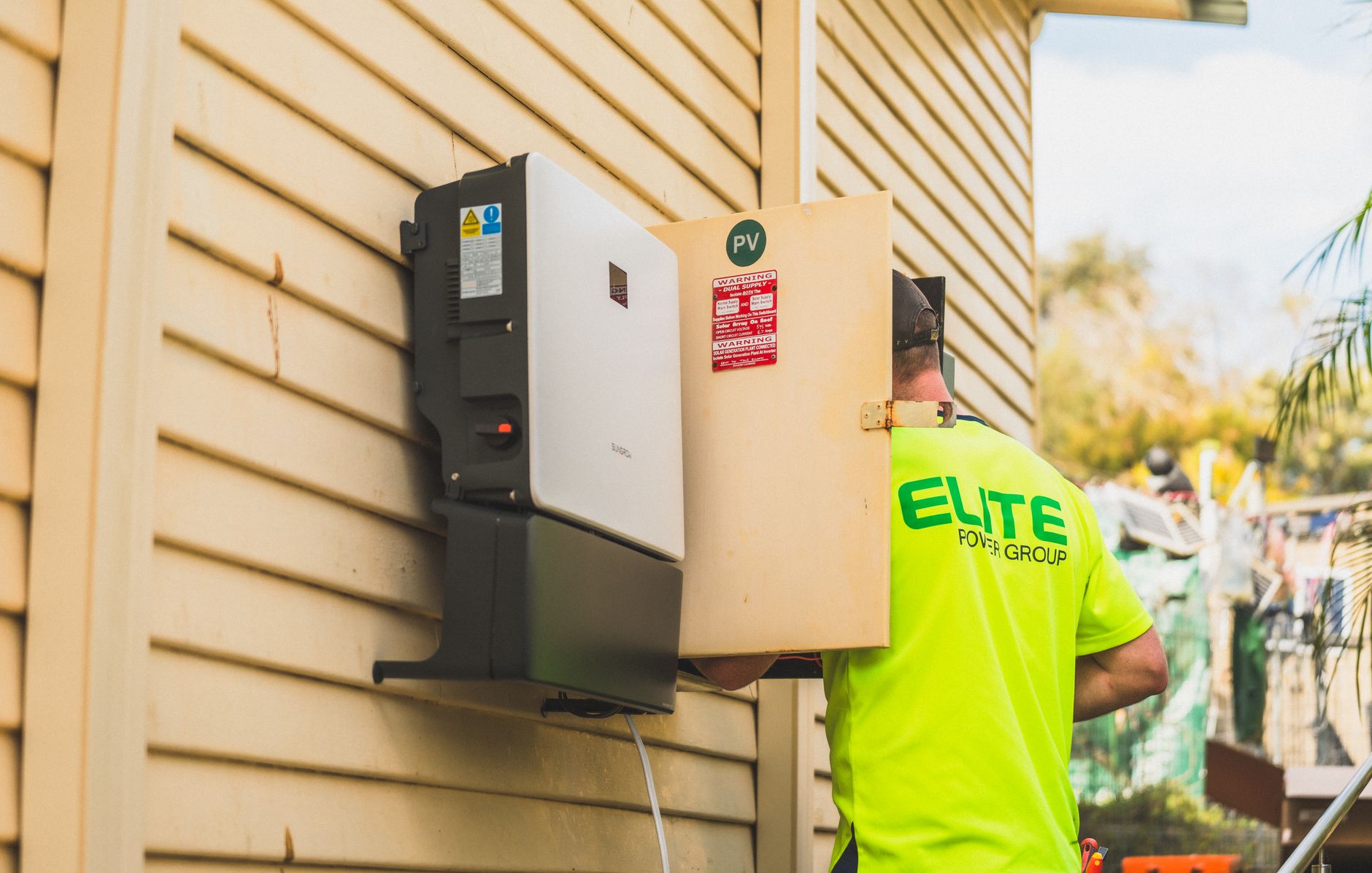
The solar inverter is the single most important component in your system after the panels themselves — it converts the direct current (DC) electricity generated by panels into the alternating current (AC) your home uses. But “inverter” covers three quite different technologies: string inverters, microinverters, and DC power optimisers paired with a central inverter. The right choice for your home depends on your roof’s orientation, how much shading it gets, your monitoring preferences, and your budget. This guide explains how each type works, compares them head-to-head, and covers the main UK brands and typical costs.
String Inverters: The Standard Choice for Most UK Homes
A string inverter connects all your solar panels in series — a “string” — and converts the combined DC output into AC at a single central unit, typically mounted on an interior wall near your consumer unit. This is the technology most UK installers fit as standard, and for good reason: string inverters are reliable, cost-effective, and have a long track record.
How string inverters work
Panels in a string share the same current path. The inverter operates each string at a maximum power point (the MPPT — Maximum Power Point Tracking), finding the voltage that extracts the most power from the string as a whole. Most modern string inverters have two or more MPPT inputs, allowing different strings (for example, an east-facing and a west-facing array) to be optimised independently.
The shading problem
The weakness of a pure string inverter is shading sensitivity. Because panels share a current path, the output of the entire string is limited by the weakest panel. A single panel partially shaded by a chimney at 10:00 on a winter morning can reduce the output of six or eight other fully-lit panels significantly. For completely unshaded roofs with all panels facing the same direction, this does not matter. For any roof with chimneys, dormers, rooflights, trees, or multiple orientations, it is a meaningful performance penalty.
Top string inverter brands in the UK
- SMA (Germany): Widely regarded as the premium string inverter brand, SMA’s Sunny Boy range is known for build quality and a 25-year track record. High-end pricing — £600–£1,000 for a 4–5 kW unit — but consistently rated highly for reliability.
- Solis (China/UK): Solis has become the most popular string inverter brand among UK installers for good reason — competitive pricing (£350–£600 for 4–5 kW), solid build quality, and a growing UK support network. A sensible choice for straightforward installs.
- Growatt (China/UK): Similar positioning to Solis. Growatt inverters are well-priced and increasingly common in the UK market, with hybrid versions (which integrate battery charging) available from around £700.
- GivEnergy: A UK-based brand that has grown strongly on hybrid inverters designed to pair with their own battery systems. Popular with installers focused on battery-first systems.
Power Optimisers: Panel-Level Control Without Panel-Level Inverters
A DC power optimiser is a small device mounted on or behind each individual panel. It performs MPPT at the panel level — finding the best operating point for each panel independently — before passing the optimised DC output to a central string inverter. The result: shading, soiling, or manufacturing variation on one panel does not drag down the rest of the string.
How optimisers work
Each optimiser communicates with the central inverter, which “sees” each panel individually. The system can report per-panel output, identify underperforming panels, and detect faults. SolarEdge, which pioneered this technology commercially, pairs its optimisers with a dedicated SolarEdge inverter designed specifically for optimised strings — the two are not interchangeable with other brands.
SolarEdge: the UK market leader for optimised systems
SolarEdge dominates the optimised inverter market in the UK. The system costs more than a plain string inverter — a SolarEdge inverter plus optimisers for a 12-panel system adds roughly £600–£1,000 compared to a Solis string inverter alone — but delivers measurably better output on any roof with shading or multiple orientations. SolarEdge’s monitoring portal shows per-panel data in real time. Their inverters also support battery integration with compatible storage units. The Which? solar buying guide notes that optimised systems can improve output by 5–25% on shaded roofs compared to plain string inverters.
Microinverters: Panel-Level Inversion for Maximum Independence
Microinverters take the individual panel concept all the way: each panel has its own dedicated inverter, converting DC to AC right at the panel. There is no central string inverter. The AC outputs from each panel are combined and connected to your consumer unit directly.
How microinverters work
Because every panel inverts independently, the system is inherently immune to shading losses. A deeply shaded panel simply produces less; the others operate at full capacity. Monitoring is per-panel by default. Adding extra panels later is straightforward — just add another panel and microinverter without resizing a central unit.
Enphase: the microinverter specialist
Enphase is the global leader in microinverters and the dominant brand in the UK market. Their IQ8 microinverters — the current generation — support “Sunlight Backup,” a feature that can power a small load during a grid outage using only solar, without a battery. Enphase’s Enlighten monitoring platform is widely regarded as the best panel-level monitoring available. The premium is real: an Enphase microinverter system for a 12-panel installation costs approximately £1,200–£1,800 more than an equivalent Solis string inverter setup. The Energy Saving Trust recommends getting quotes for both system types on complex or shaded roofs, since the performance uplift can justify the cost.
Comparison: String Inverter vs Microinverter vs Power Optimiser
| Feature | String inverter | Power optimiser + string inverter | Microinverters |
|---|---|---|---|
| Typical extra cost vs string baseline | Baseline (£350–£1,000 for inverter) | +£600–£1,000 for a 12-panel system | +£1,200–£1,800 for a 12-panel system |
| Shading tolerance | Low — one shaded panel affects the whole string | High — each panel tracked independently | Highest — full panel-level independence |
| Panel-level monitoring | No (string-level only) | Yes (via SolarEdge portal) | Yes (via Enphase Enlighten) |
| System efficiency (peak conditions) | 97–98% | 97–98% (optimisers add ~1–2% heat losses) | 96–97% (per panel) |
| Single point of failure risk | Yes — inverter failure stops the whole system | Yes for inverter, but optimisers safe-mode | No — one microinverter failure loses only one panel |
| Typical inverter lifespan | 10–15 years | 12–15 years | 25 years (claimed, less proven) |
| Ease of expansion | Limited by inverter capacity | Moderate — inverter must be upsized separately | Easy — add panels one by one |
| Battery compatibility | Good (AC coupling or hybrid models) | Good (SolarEdge battery ecosystem) | Good (Enphase IQ battery, or AC coupling) |
| Best for | Unshaded, single-orientation roof | Partially shaded or multi-orientation roof | Complex/heavily shaded roofs, frequent expansion |
Which Solar Inverter Type Should You Choose?
The short answer: start with the roof, not the brand preference.
- Unshaded south-facing roof, all panels the same orientation: A quality string inverter (Solis, SMA, Growatt) is the right choice. You will not get a meaningful return from optimisers or microinverters, and you save £600–£1,800 upfront.
- Partially shaded roof, or panels on two different orientations (east/west split): Power optimisers — specifically SolarEdge — deliver a measurably better yield at a moderate premium. This is the most common scenario in UK terraced and semi-detached housing, where chimney stacks are a constant factor.
- Heavily shaded or complex roof, phased installation, or wanting maximum monitoring detail: Microinverters (Enphase IQ8) are worth the premium. They are also the best choice if you want to add panels incrementally over time without worrying about inverter capacity.
Our solar panel costs guide includes a section on how inverter choice affects overall system pricing. Before finalising your specification, use the solar savings calculator to estimate your generation — this will help you assess whether the output improvement from optimisers or microinverters justifies the extra spend on your specific roof. And see our guide to choosing an MCS-certified installer to make sure you are getting honest advice on inverter technology, not a sales pitch for whichever product your installer stocks.
A Note on Hybrid Inverters
Hybrid inverters combine the solar inverter and battery inverter/charger into one unit. Most of the major brands now offer hybrid versions: Solis has its hybrid range, Growatt has the SPH series, GivEnergy builds their battery systems around hybrid units, and SolarEdge’s Home Hub is a hybrid product. If you are planning to add battery storage — which makes strong financial sense given the Ofgem-regulated Smart Export Guarantee rates for excess generation — specifying a hybrid inverter from the start is cheaper than retrofitting later. Our home battery storage guide covers hybrid inverter selection in detail.