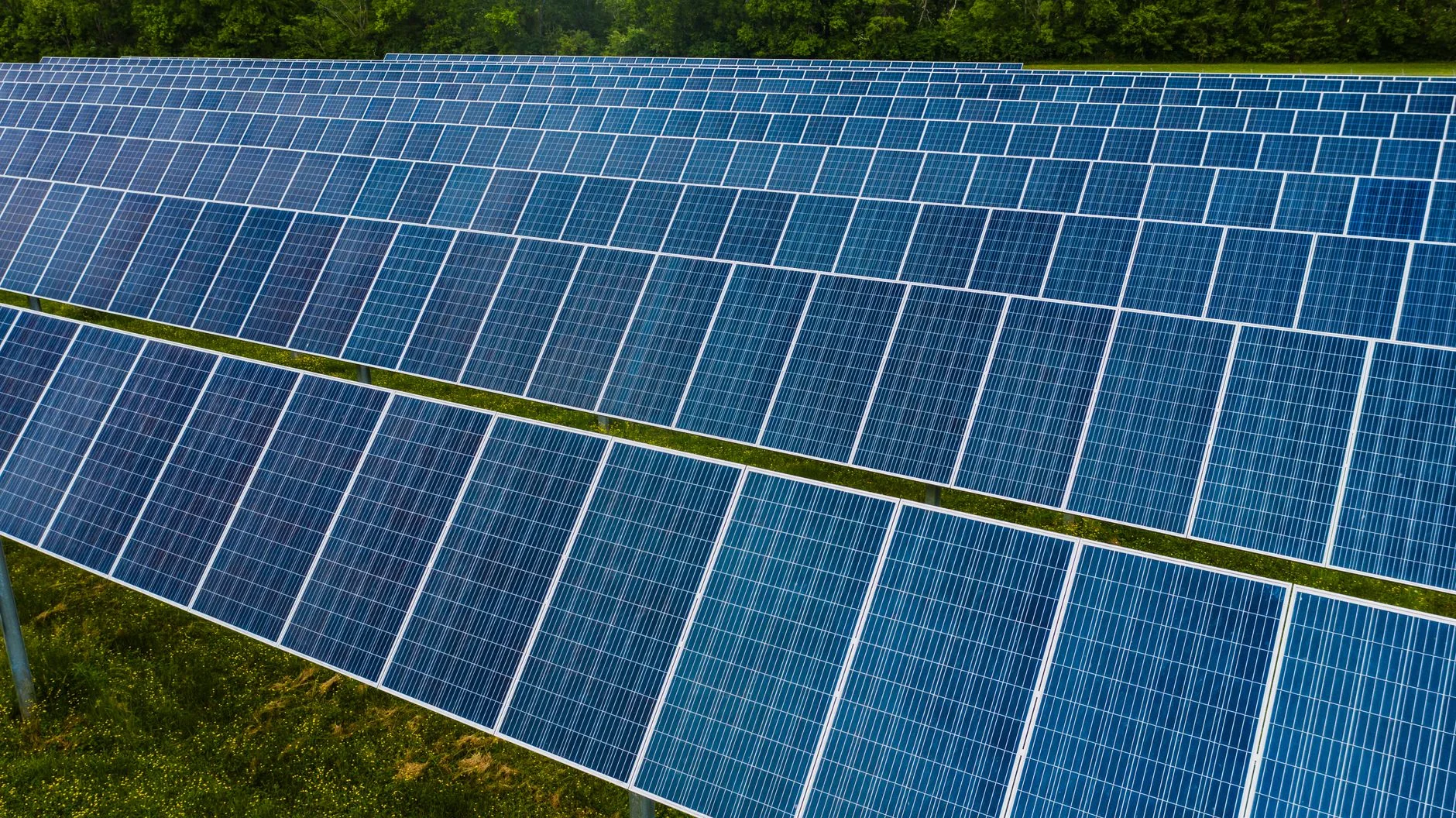
North-facing solar panels in the UK generate around 30–40% less electricity than south-facing panels — a real reduction. But it does not automatically mean the installation is not worth doing. With electricity prices at record highs, larger panel arrays at lower cost, and the ability to optimise tilt angle, a north-facing solar installation can still deliver a reasonable payback period. This guide explains exactly what to expect, when it makes financial sense, and when to explore alternatives like an east/west split or ground mount.

Key Takeaways
- North-facing solar panels in the UK generate 30–40% less electricity than south-facing panels of the same capacity
- East/west split installations perform much better — only 15–20% below south-facing — and smooth out the generation curve across the day
- North-facing installs can still be financially viable on large roofs where oversizing (by 20–30%) compensates for reduced output
- UK solar irradiance data (PVGIS) shows north-facing systems still generate a usable 600–700 kWh/kWp per year
- High UK electricity prices (24–30p/kWh) mean even reduced north-facing output still delivers real bill savings
- Always get a detailed shading and orientation analysis using PVGIS or equivalent tool before proceeding
How Much Less Do North-Facing Solar Panels Generate in the UK?
UK solar irradiance data gives us reliable figures for the output reduction by orientation. The Energy Saving Trust’s solar guidance and industry benchmarks consistently show the following relative performance compared to an optimally pitched south-facing array:
| Roof Orientation | Pitch | Annual Output vs South-Facing Optimum |
|---|---|---|
| South-facing | 30–40° | 100% (baseline) |
| South-east / South-west | 30–40° | ~95% |
| East-facing | 30–40° | ~80% |
| West-facing | 30–40° | ~80% |
| North-east / North-west | 30–40° | ~65–70% |
| North-facing | 30–40° | ~55–70% |
| North-facing (low pitch, 10–15°) | 10–15° | ~65–75% |
The reduction is real but perhaps not as severe as many people assume. A north-facing roof at a relatively shallow pitch — common on many UK bungalows and semi-detached homes — performs noticeably better than a steep north-facing surface, because it presents a less extreme angle to the sky. The worst case is a steep (45°+) north-facing roof, where output can fall to 55% of south-facing performance.
In absolute terms: a 4 kWp south-facing system in central England might generate around 3,400 kWh per year. The same system north-facing would generate approximately 1,900–2,380 kWh. At a self-consumption value of 24p/kWh plus export earnings, that is still £500–£650 in annual savings — respectable, though below the south-facing equivalent of £850–£1,100.
When a North-Facing Solar Installation Still Makes Financial Sense
The payback arithmetic on north-facing solar is tighter, but several scenarios still tip the balance in favour of installing:
When the north-facing roof is larger than the south
If your south-facing slope is small (say, 8 panels’ worth) but your north-facing slope is large enough for 16 panels, you may generate more total electricity from the north-facing side despite the per-panel reduction. Total kWh generated, not per-panel efficiency, is what drives savings and payback. A larger system at 65% performance can outperform a smaller system at 100%.
When south-facing space is obstructed or unusable
Chimneys, roof lights, dormers, and party wall restrictions frequently make south-facing roof sections unsuitable for panels. If your south-facing space accommodates only 4–6 panels and your north-facing roof is clear, combining both sides — or going north-only if south-only yields very little — can make sense. Your installer should model both options and show you the generation estimates side by side before you decide.
When energy prices are high and self-consumption is good
At current energy prices (24–26p/kWh), even the lower output of a north-facing system delivers meaningful savings. If you self-consume the majority of what you generate — because you work from home, run a heat pump, or charge an EV during the day — the reduced generation still displaces significant grid imports. The payback period on a north-facing system at current prices is typically 12–16 years rather than 8–10 years. For a homeowner planning to stay for 20+ years, that may still be worthwhile. Use our solar savings calculator to model the numbers for your specific roof.
When the alternative is no solar at all
The comparison should be north-facing solar vs no solar — not north-facing vs south-facing. If your only viable roof space is north-facing, the relevant question is whether any solar is better than none, not whether it matches a hypothetical ideal installation. For most households, some generation is significantly better than zero, particularly if you can pair it with a time-of-use tariff to maximise the value of what you do generate.
East/West Split Arrays: Often the Best Solution for Complex Roofs
If your property has both east and west-facing roof slopes but no south-facing option — as is common with ridge-to-ridge terraced houses in UK cities — an east/west split array is frequently a better solution than north-facing installation. An east/west system generates around 80% of south-facing output in total, with the additional advantage of a flatter generation curve across the day: east panels generate strongly in the morning, west panels in the afternoon, so you produce useful electricity for longer.
This extended generation profile is particularly valuable for households that want to maximise self-consumption without a battery, since the output is spread across a longer daily window rather than concentrated in a three-hour midday peak. East/west is also common on commercial flat roofs, where panels can be installed at low pitch facing both directions on a purpose-built frame. The Solar Trade Association’s technical resources cover east/west array design for UK installations.
Microinverters and Optimisers: Essential for North-Facing Installations?
On a standard string inverter, all panels in a series string must operate at the current of the weakest panel. This is fine when all panels receive similar irradiance — but a north-facing array in the UK will always have lower and more variable irradiance than a south-facing one, with larger variation between panels at different times of day. Shading from the roof ridge, chimneys, or adjacent buildings can create significant mismatch, dragging down whole-string output.
This is the primary reason that DC power optimisers (from manufacturers like SolarEdge or Tigo) or microinverters (from Enphase) are particularly worth considering for north-facing installations:
- DC optimisers (e.g. SolarEdge P-Series): Each panel has its own optimiser that performs maximum power point tracking (MPPT) independently. A shaded or underperforming panel no longer limits the rest. Added cost: typically £80–£150 per panel, so £800–£1,500 extra for a 10-panel system.
- Microinverters (e.g. Enphase IQ8): Each panel has its own inverter, converting DC to AC at the panel rather than at a central unit. Panels operate completely independently. Added cost: typically £100–£200 per panel extra over a string inverter system, but you gain panel-level monitoring as a bonus.
For a north-facing array where some panels may be in partial shade from the roofline or ridge tiles at low sun angles, the uplift from optimisers can be 5–15% of total generation — meaningful when you are already starting from a reduced baseline. Whether that uplift justifies the cost depends on system size; get your installer to model it with and without optimisers. Our solar panel costs guide includes a breakdown of what optimisers and microinverters add to a typical UK installation budget.
Real Generation Data: What North-Facing Systems Actually Produce
Community data from PVOutput.org — where UK solar owners voluntarily log their daily generation — backs up the theoretical figures. North-facing systems in the UK show:
- Annual generation roughly 30–40% below south-facing equivalents of the same rated capacity in the same region
- More pronounced seasonal variation — winter output is disproportionately affected, while summer months see less relative penalty (sun is high in the sky and diffuse light from the sky contributes more)
- Performance particularly sensitive to roof pitch — a 15° north-facing roof outperforms a 45° north-facing roof by a substantial margin in annual total generation
The Ofgem SEG framework applies equally to north-facing installations — your export income is not penalised for roof orientation, only your generation volume is lower. This means the administrative process for claiming SEG payments is identical regardless of orientation.
Getting an Honest Quote for a North-Facing System
The most important step before committing to a north-facing installation is getting generation estimates that are specific to your roof — not generic south-facing figures. Any reputable MCS-certified installer should provide a site-specific generation estimate using tools like PVsyst or SAP, based on your roof’s actual orientation, pitch, latitude, and shading profile. Ask for the estimate in writing and ask what assumptions it makes about self-consumption and export.
Also ask your installer to model the east/west alternative if your property has suitable east or west slopes. In many cases, the east/west option generates more total electricity at comparable or lower cost than a north-only installation. The right answer depends on your specific roof geometry — there is no universal rule.
North-facing solar is not the first choice, but it is far from the worst. For UK homeowners with limited south-facing space, it can still be a financially sound decision at current energy prices, particularly when paired with a smart tariff and active consumption management. Read our guide to the Smart Export Guarantee to understand how to maximise the value of whatever you do generate, regardless of orientation.