How-To
Solar Panels for Self-Build Homes in the UK
Self-build is the best opportunity to integrate solar properly — before walls go up and cables get buried. Here is…
September 30, 2026
Read more →
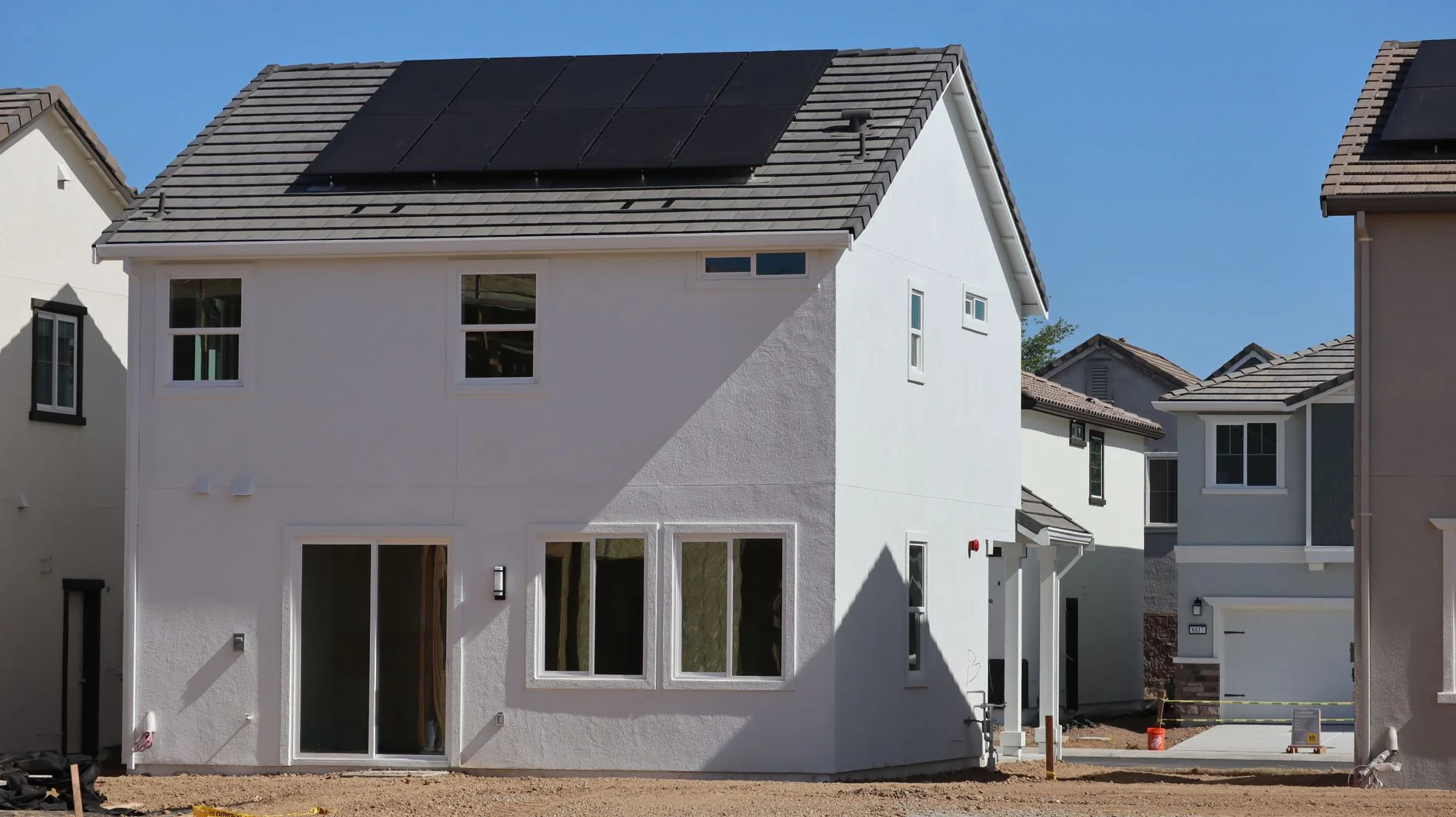
Solar panels on new build homes in the UK have moved from a premium option to something close to a standard feature — driven by tightening building regulations and the looming Future Homes Standard. If you are buying a new build in 2026, there is a reasonable chance the house already has solar panels on the roof. But understanding what you have, what you are entitled to know, and what you might want to add is more complex than the developer’s brochure suggests. This guide explains the regulatory landscape, what to ask your developer, and how to make the most of a solar-equipped new build.
The Future Homes Standard (FHS) is the UK government’s planned upgrade to building regulations for new homes. Under its framework, new homes built from 2025 onwards (in England) must produce 75–80% lower carbon emissions than homes built to 2013 Part L standards. The government’s Future Homes Standard consultation sets out the detail, but in practice it means almost all new homes will need a combination of heat pumps, high-specification insulation, and on-site renewable generation — of which solar PV is the most common solution.
The FHS does not mandate solar panels specifically — developers can meet the standard through other means — but solar PV is the most cost-effective route for the majority of house types. As a result, solar has become the dominant compliance pathway. By 2026, the proportion of new homes built with solar panels is significantly higher than just three years ago.
While the full Future Homes Standard is being phased in, Part L of the Building Regulations already requires new homes to meet fabric energy efficiency standards and limit carbon emissions. The 2021 revision (effective from June 2022) tightened the rules substantially — new homes must now emit 31% less CO₂ than under the 2013 standards. Many developers find that solar PV is the most straightforward way to meet this requirement, particularly for semi-detached and detached house types with adequate south-facing roof area.
Flats and terraces present more of a challenge due to limited roof area per dwelling — developers may instead opt for enhanced insulation, heat pumps, or communal solar arrays on apartment blocks. If you are buying a flat in a new development, ask specifically how the developer has complied with Part L, since roof-mounted solar may not be part of your individual property.
Every new home in the UK must be assessed using the Standard Assessment Procedure (SAP), which calculates the home’s energy efficiency rating (1–100+) and its Environmental Impact Rating (EIR). Solar panels boost both scores significantly. A 4 kWp solar system can add roughly 10–20 SAP points to a house’s rating — enough to move a B-rated home to an A.
When buying a new build, ask for the home’s SAP calculation document (also called the SAP worksheet or Predicted Energy Assessment, or PEA). This will show exactly what solar system has been modelled — its size in kilowatts peak (kWp), the assumed orientation, and how many MWh of generation it is credited with per year. Compare this to the physical system quoted on the technical specification sheet. Discrepancies are rare but worth checking.
The Energy Saving Trust’s solar panel guidance is useful background reading for understanding how solar generation translates to energy bill savings in a new build context.
Not all developer-installed solar is equal. Housebuilders operate at scale and choose panels, inverters, and installation contractors based on build cost as much as quality. Before exchanging contracts, ask your developer the following questions:
Most developer-installed solar systems in 2026 do not include battery storage. This is a significant missed opportunity: a battery allows you to store surplus solar generation for use in the evening, cutting your grid electricity consumption substantially. New builds are well suited to battery storage because the electrical installation is new, battery sizing can be designed in from the start, and there are no legacy wiring complications.
Adding a battery retrospectively to a developer-installed system is straightforward provided the inverter is battery-compatible or a hybrid inverter upgrade is acceptable. Popular batteries for UK new builds include the GivEnergy 9.5 kWh, Sunsynk 5.32 kWh, and Tesla Powerwall 3. Costs for battery-only installation typically run £4,000–£8,000 depending on capacity. Our home battery storage guide covers all the leading options, what to look for, and how to calculate what size battery suits your household.
Some new build developers now offer battery storage as an upgrade option at point of sale — it is worth asking, as the installation cost is often lower when done during construction rather than retrospectively.
If your new build solar system is MCS-certified, you can register for the Smart Export Guarantee and earn money for every unit of surplus electricity you export to the grid. Rates in 2026 range from around 4p to 20p+ per kWh depending on the tariff you choose. To register, contact an energy supplier that offers SEG tariffs (Octopus Energy, Ovo, British Gas, and others) and provide your MCS certificate number.
This is genuinely free money — you need to do nothing except choose a good tariff. The Ofgem SEG guidance lists all licensed suppliers and their obligations. Our dedicated Smart Export Guarantee guide compares current tariff rates and tells you which suppliers offer the best deals in 2026.
| Question | Why it matters |
|---|---|
| What is the solar system size (kWp)? | Determines generation capacity and savings potential |
| What panels and inverter are installed? | Quality varies significantly by brand |
| Is the system MCS-certified? | Required for Smart Export Guarantee |
| What warranties transfer to me? | Protects you against panel and inverter defects |
| Is battery storage available as an upgrade? | Cheaper during construction than retrospective install |
| Is the roof designed for future panel expansion? | Some developers future-proof wiring runs |
| What monitoring system is included? | Needed to track output and detect faults |
| Is there an EV charging point or provision? | Pairing solar and EV charging maximises savings |
If you are considering pairing your new build solar with an electric vehicle charger — which makes excellent financial sense — our solar panels and EV charging guide explains how to design the system for maximum benefit. Use our solar savings calculator to estimate what your specific new build system size and location should generate, and what that means for your annual bills.
The Solar Trade Association’s new homes solar guidance provides industry-level context on what standards consumers should expect from developer-installed systems — useful reading before your developer handover meeting.
Self-build is the best opportunity to integrate solar properly — before walls go up and cables get buried. Here is…

Garage and outbuilding roofs are often better solar locations than the main house — south-facing, unshaded, and away from chimney…

A solar immersion diverter routes excess solar electricity to your hot water cylinder, cutting your gas or electric immersion costs.…